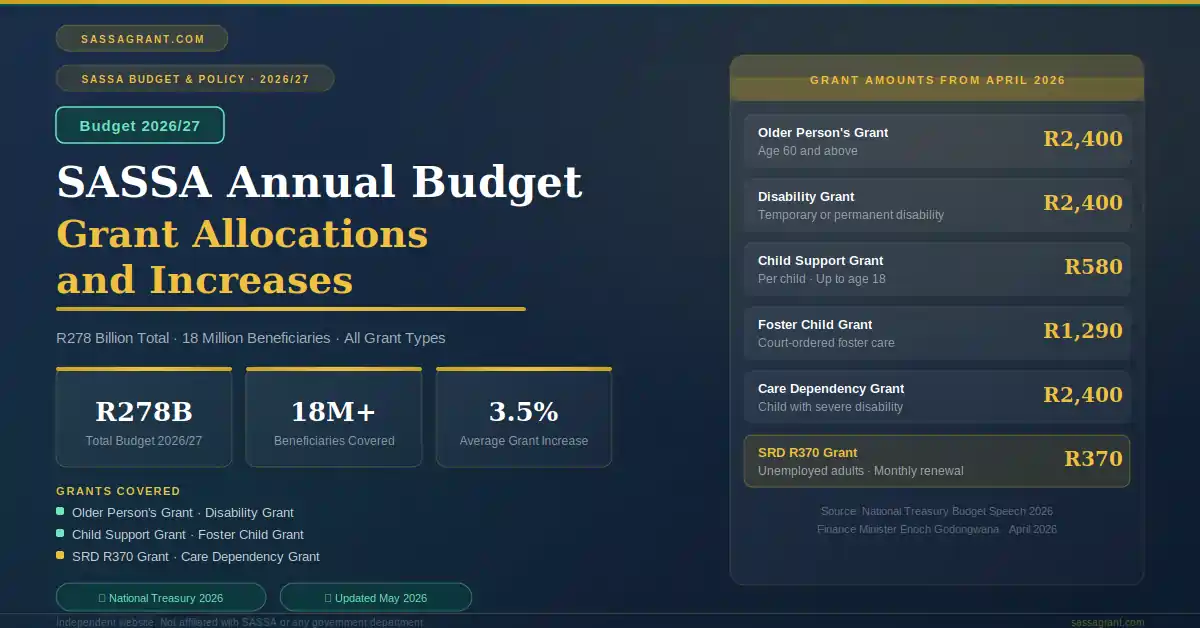
SASSA Annual Budget 2026/27. Grant Allocations and Increases
R330.5 billion for direct grant payments. R446.6 billion total Social Development allocation. 26.5 million beneficiaries. Above-inflation increases for permanent grants from April 2026.
Read the Official 2026/27 Budget Review
Verify all figures directly with National Treasury and SASSA.
The SASSA annual budget for 2026/27 is R330.5 billion for direct grant payments. Total Social Development allocation is R446.6 billion. This covers 26.5 million beneficiaries. Most grants received above-inflation increases from April 2026. The Child Support Grant rose to R580. Old Age and Disability grants rose to R2 400. The SRD R370 grant remained unchanged.
Finance Minister Enoch Godongwana delivered the budget on 25 February 2026. The second budget under the Government of National Unity.
- What Is the SASSA Annual Budget
- Total Social Development Budget 2026/27
- Updated SASSA Grant Amounts from April 2026
- How Many People Does SASSA Support
- Why Did Some Grants Increase and Not Others
- What the Budget Means for SRD R370 Recipients
- The Future of the SRD Grant. Livelihoods Support Grant
- How SASSA Is Fighting Fraud in 2026
- What the Budget Means for You as a Beneficiary
- Frequently Asked Questions
- ✓Total SASSA grant budget is R330.5 billion for direct payments in 2026/27. Total Social Development allocation is R446.6 billion.
- ✓Most grants increased above inflation from April 2026. Old Age and Disability rose to R2 400. Child Support rose to R580.
- ✓SRD R370 grant stays at R370 but is extended until March 2027.
- ✓26.5 million South Africans receive SASSA grants in 2026/27. These are close to 40% of the population.
- ✓Foster Child Grant rises to R1 300 from October 2026. A confirmed secondary increase.
- ✓Livelihoods Support Grant is coming. It will replace the SRD grant and be conditional on job-seeking or training.
- ✓SASSA fraud prevention has saved R170 million through grant reviews. Over 34,000 ineligible grants cancelled.
- ✓Complete your eKYC verification if requested. Swap your Gold Card to the Black Card immediately.
- ✓Finance Minister Enoch Godongwana delivered the budget on 25 February 2026.
1. What Is the SASSA Annual Budget
Every year, South Africa’s Finance Minister stands before Parliament and delivers the National Budget. This moment matters deeply to millions of South Africans, because it determines how much money flows into their homes every month through SASSA grants.
On 25 February 2026, Finance Minister Enoch Godongwana delivered the 2026/27 National Budget. It was the second budget under the Government of National Unity.
The budget had good news for most grant recipients. Above-inflation increases for permanent grants. Continued extension of the SRD grant. And a significant total allocation for social assistance.
2. Total Social Development Budget 2026/27
The SASSA budget for 2026/27 sits within the broader Social Development allocation. Here is the full picture.
| Budget Item | Amount |
|---|---|
| Total Social Development Allocation | R446.6 billion |
| Direct Grant Payments to Beneficiaries | R330.5 billion |
| Child Support Grant Allocation | R89.0 billion |
| Old Age Grant Allocation | R121.8 billion |
| SRD R370 Grant Allocation | R36.9 billion |
| Other Grants and Assistance | R82.0 billion |
How allocations compare visually
This R446.6 billion makes Social Development one of the largest spending areas in the entire national budget. Only Learning and Culture at R527.2 billion receives more funding.
Social spending represents approximately 60% of all non-interest government expenditure. This reflects South Africa’s deep commitment to protecting its most vulnerable citizens.
The total consolidated national budget revenue for 2026/27 is R2.35 trillion. South Africa’s debt is projected to peak at 78.9% of GDP in 2025/26 before beginning a decline. This fiscal stability made the grant increases possible.
3. Updated SASSA Grant Amounts from April 2026
All permanent grant increases took effect from 1 April 2026. These are the confirmed amounts.
| Grant Type | From April 2026 | Increase | Percentage |
|---|---|---|---|
| Old Age Grant (60–74 years) | R2 400 | +R80 | 3.7% |
| Old Age Grant (75+ years) | R2 420 | +R80 | 3.4% |
| Disability Grant | R2 400 | +R80 | 3.7% |
| Care Dependency Grant | R2 400 | +R80 | 3.7% |
| War Veterans Grant | R2 420 | +R80 | 3.6% |
| Foster Child Grant | R1 290 | +R40 | 3.6% |
| Child Support Grant | R580 | +R20 | 3.6% |
| Grant in Aid | R580 | +R20 | 3.6% |
| SRD R370 Grant | R370 | No change | 0% |
These increases were designed to keep pace with inflation. CPI inflation for 2026 is projected at 3.4%. Most grant increases match or slightly exceed this level, preserving the real value of the grants for beneficiaries.
4. How Many People Does SASSA Support
SASSA supports 26.5 million beneficiaries in the 2026/27 cycle. This is nearly 40% of South Africa’s entire population.
| Grant Type | Estimated Beneficiaries 2026/27 |
|---|---|
| Child Support Grant | 12.6 million |
| Old Age and War Veterans | 4.27 million |
| SRD R370 Grant | 8.2 million |
| Disability Grant | 1.07 million |
| Care Dependency Grant | 184,000 |
| Foster Child Grant | 154,000 |
The Child Support Grant remains the largest by volume, supporting 12.6 million children across South Africa.
The SRD R370 grant is growing, from 7.7 million in 2025/26 to 8.2 million in 2026/27. This reflects continued high unemployment among working-age adults between 18 and 59.
The Foster Child Grant is expected to see a decrease in recipients. It is from 184,000 down to 154,000. This is due to SASSA intensifying its verification and eligibility checks.
5. Why Did Some Grants Increase and Not Others
This is a fair question. Many beneficiaries are frustrated that the SRD R370 grant did not increase.
The permanent grants increased because they are long-term social commitments. They support the elderly, disabled, and children. These are recognised as essential income for households that have no other means.
The SRD grant did not increase because it was designed as a temporary emergency measure. It was introduced during the COVID-19 pandemic in 2020. It has been extended multiple times. But the National Treasury views it as a transitional programme. It is not a permanent fixture. As a result, the amount stays frozen at R370 per month.
Civil society groups have strongly criticised this decision, arguing that R370 does not cover the cost of a basic food basket.
The Pretoria High Court also ruled in 2025 that the R625 income threshold for the SRD grant is unconstitutional and must be progressively increased. The government has appealed this ruling, and the legal matter continues.
6. What the Budget Means for SRD R370 Recipients
The SRD R370 grant has been extended until 31 March 2027. The government allocated R36.9 billion for this extension.
- Amount stays at R370 per month. It has not changed since 2022.
- Payments continue in batches during the last week of each month, typically between the 24th and 30th.
- Income threshold remains R625 per month. Even a one-time family gift above this can trigger a decline.
- 8.2 million unemployed South Africans will continue receiving support through to early 2027.
Despite the frustration around the frozen amount, the extension itself is important. It confirms continued financial support for millions of working-age adults with no other income.
7. The Future of the SRD Grant. Livelihoods Support Grant
The most significant policy announcement in the 2026/27 budget for SRD recipients is the planned redesign of the grant.
President Cyril Ramaphosa announced that the SRD grant will be transformed into a Livelihoods Support Grant. This is a fundamental shift in philosophy.
Current SRD Grant: Unconditional
You receive it if you qualify financially. No other requirements attached.
Future Livelihoods Support Grant: Conditional
Beneficiaries may need to register on government job-seeker databases, participate in skills training, or engage in learnerships or community work.
The public consultation period closed on 30 April 2026. Over 45,000 submissions were received. The Department of Social Development is reviewing them. A final policy announcement is expected during the Medium-Term Budget Policy Statement in late 2026.
8. How SASSA Is Fighting Fraud in 2026
The 2026/27 budget includes significant investment in fraud prevention. This directly affects how grants are verified and paid.
Biometric Verification
SASSA has intensified its eKYC system. This uses facial recognition to confirm that grant recipients are who they claim to be. It has already saved approximately R44 million per month by identifying fraudulent claims.
Database Cross-Checking
Every grant recipient is checked monthly against SARS, UIF, NSFAS, and Home Affairs records. Any income above the means test threshold triggers an automatic review or decline.
Grant Reviews
SASSA reviewed nearly 300,000 grant recipients in the past cycle. Over 34,000 non-qualifying grants were cancelled, generating savings of approximately R170 million.
Impact on Beneficiary Numbers
These tightened checks are why the Foster Child Grant recipient numbers are expected to drop from 184,000 to 154,000 over two years. And Child Support Grant numbers from 12.9 million to 12.38 million over the same period.
9. What the Budget Means for You as a Beneficiary
Here is a practical summary of what the 2026/27 budget means for your daily life.
- OA
If you receive the Old Age Grant
Your monthly payment increased by R80 to R2 400 from April 2026. If you are 75 or older, your amount is R2 420.
- DG
If you receive the Disability Grant
Your monthly payment increased by R80 to R2 400 from April 2026.
- CS
If you receive the Child Support Grant
Your monthly payment per child increased by R20 to R580 from April 2026.
- FC
If you are a foster parent
Your monthly payment per child increased by R40 to R1 290 from April 2026. A further increase to R1 300 is confirmed from October 2026.
- SR
If you receive the SRD R370 grant
Your amount stays at R370. The grant continues until March 2027.
- ALL
For all beneficiaries
Make sure your banking details are correct. Complete any eKYC verification requests immediately.
10. Frequently Asked Questions
Sources and References
- →National Treasury South Africa. 2026/27 Budget Review. February 25 2026.
- →Finance Minister Enoch Godongwana. Budget Speech 2026.
- →South African Social Security Agency. Grant Amounts and Allocations 2026/27.
- May 2026: Article published. Includes full 2026/27 budget breakdown, April 2026 grant increases.