8 Types of SASSA Grants in South Africa and How to Apply
All 8 SASSA grant types explained. Who qualifies. Current 2026 amounts. Documents required. Step by step application guide.
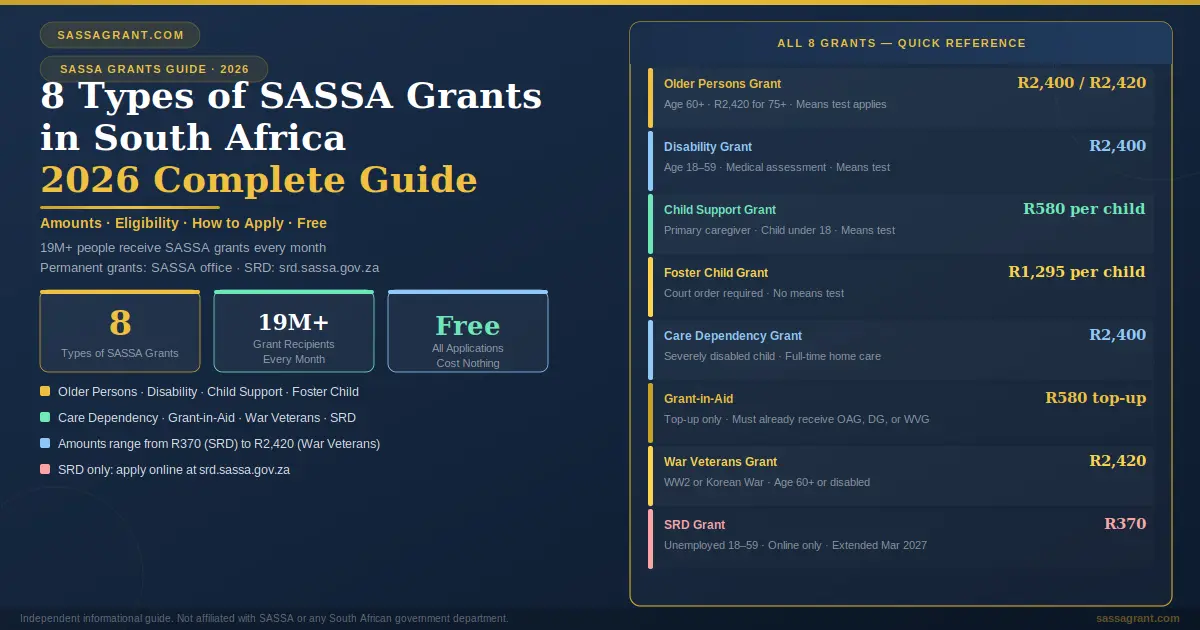
There are 8 types of SASSA grants in South Africa. They are the Older Persons Grant, Disability Grant, Child Support Grant, Foster Child Grant, Care Dependency Grant, Grant-in-Aid, War Veterans Grant, and the Social Relief of Distress (SRD) Grant. Each grant has its own eligibility rules, monthly amount, and application process. Applications are free of charge at any SASSA office.
Apply for a SASSA Grant Today
Visit your nearest SASSA office. Or apply for SRD R370 online at srd.sassa.gov.za. Free.
- What Are the 8 Types of SASSA Grants
- Grant 1: Older Persons Grant
- Grant 2: Disability Grant
- Grant 3: Child Support Grant
- Grant 4: Foster Child Grant
- Grant 5: Care Dependency Grant
- Grant 6: Grant-in-Aid
- Grant 7: War Veterans Grant
- Grant 8: Social Relief of Distress (SRD) Grant
- SASSA Means Test: Do You Qualify
- How to Apply for a SASSA Grant: Step by Step
- Can You Apply for SASSA Grants Online
- Key Takeaways
- Sources and References
1. What Are the 8 Types of SASSA Grants
There are 8 types of SASSA grants currently offered in South Africa. SASSA, the South African Social Security Agency, distributes these grants to over 19 million people every month.
Each grant is designed for a specific group. Some are for the elderly. Some are for people with disabilities. Some are for children. And one is for people who are unemployed and have absolutely nothing to survive on right now.
These grants are not charity. They are a right. They are written into South African law. And they exist because real people, real grandmothers, real children, real disabled adults, need real help every single month.
| # | Grant Name | Monthly Amount | Who It Is For |
|---|---|---|---|
| 1 | Older Persons Grant | R2,400 / R2,420 (75+) | South Africans aged 60 and above |
| 2 | Disability Grant | R2,400 | Adults aged 18–59 with qualifying disability |
| 3 | Child Support Grant | R580 per child | Primary caregivers of children under 18 |
| 4 | Foster Child Grant | R1,295 per child | Court-appointed foster parents |
| 5 | Care Dependency Grant | R2,400 | Caregivers of severely disabled children |
| 6 | Grant-in-Aid | R580 (top-up) | Those on OAG, DG, or WVG needing full-time care |
| 7 | War Veterans Grant | R2,420 | Veterans of World War 2 or Korean War |
| 8 | SRD Grant | R370 | Unemployed adults aged 18–59 with no income |
2. Older Persons Grant
R2,420 for age 75+
The Older Persons Grant pays R2,400 per month to South African citizens aged 60 and older who cannot financially support themselves. Citizens aged 75 and older receive R2,420 per month.
This is the grant most people call the “old age pension.” Millions of elderly South Africans depend on it. For many, it is their only income. And it often supports not just the pensioner, but the whole household.
Who Qualifies
- South African citizen, permanent resident, or recognised refugee
- 60 years old or older
- Must pass the means test. Single applicant must earn less than R101,640 per year.
- Must not be living in a state-funded institution
- Must not be receiving another SASSA grant

3. Disability Grant
The Disability Grant pays R2,400 per month to South Africans aged 18 to 59 who have a medically assessed disability that prevents them from working. It is one of the most life-changing grants for people who have no other way to earn a living.
Living with a disability is hard enough on its own. Not being able to work makes it harder. This grant exists so that no South African has to face that alone.
Who Qualifies
- South African citizen, permanent resident, or recognised refugee
- Between 18 and 59 years old
- A disability that is physical or mental in nature
- The disability must have lasted longer than six months or be permanent
- Medical assessment report from a state-appointed doctor. Not older than 3 months.
- Must pass the means test. Must not be in a state-funded institution.
4. Child Support Grant
per month
The Child Support Grant pays R580 per month per child to the primary caregiver of children under 18. It is the most widely received grant in South Africa. Millions of caregivers, mostly mothers and grandmothers, depend on it. For more details, see our Child Support Grant payment dates 2026.
A child costs money. Food, clothes, school supplies, transport. R580 is not a fortune. But it is something. And for many families, it is the difference between eating and going hungry.
Who Qualifies
- The child must be under 18 years old and live in South Africa
- You must be the primary caregiver. This can be a parent, grandparent, aunt, uncle, or any person who is the main caregiver.
- Must pass the means test. A single caregiver must earn less than R60,000 per year.
- The child must not be living in a state-funded institution.
5. Foster Child Grant
per month
The Foster Child Grant pays R1,295 per month to foster parents who have been legally appointed by a court to care for a child. This grant is higher than the Child Support Grant because the legal responsibilities of foster care are greater.
Foster parents take on a child who cannot be cared for by their own family. They provide a home, love, and stability. This grant helps them do that.
Who Qualifies
- You must have legal foster care status granted by a court order
- The child must be legally placed in your care by a court
- There is no means test for the Foster Child Grant
Without the court order, you cannot receive this grant. And if the court order expires or is rescinded, the grant stops automatically.
6. Care Dependency Grant
The Care Dependency Grant pays R2,400 per month to parents or caregivers of children under 18 who have severe disabilities requiring full-time care at home. This grant recognises that caring for a severely disabled child is a full-time commitment that prevents a caregiver from working.
Caring for a child with a severe disability is one of the hardest things a parent can do. The emotional and physical toll is enormous. And this grant is a small recognition of that sacrifice.
Who Qualifies
- The child must be under 18 years old with a severe mental or physical disability
- The disability must require full-time care at home
- A medical assessment from a state-appointed doctor is required. Not older than 3 months.
- The caregiver must pass a means test. The child must not be in a state-funded institution.
7. Grant-in-Aid
top-up only
The Grant-in-Aid pays an additional R580 per month to people who already receive an Older Persons, Disability, or War Veterans Grant and who also need full-time care from another person. It is not a standalone grant. It is a top-up.
Sometimes a disability or old age becomes so severe that the person cannot care for themselves at all. They need someone to bathe them, feed them, and stay with them. And this grant helps pay for that care.
Who Qualifies
- You must already be receiving an Older Persons Grant, a Disability Grant, or a War Veterans Grant
- You must be unable to care for yourself due to your physical or mental condition
- You must require full-time care from another person
8. War Veterans Grant
The War Veterans Grant pays R2,420 per month to South Africans who fought in World War II or the Korean War and who can no longer financially support themselves. This grant honours a very small and elderly group of South Africans.
The number of living war veterans who qualify grows smaller every year. But for those who are still here, this grant is a recognition of their sacrifice.
Who Qualifies
- Must have fought in World War II or the Korean War as a member of the South African forces
- Must be 60 years old or older, OR must have a disability
- Must not be able to support yourself financially. Must pass the means test.
9. Social Relief of Distress (SRD) Grant
Extended to March 2027
The Social Relief of Distress (SRD) Grant pays R370 per month to unemployed South Africans aged 18 to 59 who have no other income and no other support. It is a temporary grant that has been extended to March 2027. For complete details, see our SRD R370 Grant Guide.
R370 is not enough to live on. Nobody pretends it is. But for someone with truly nothing, it is something to eat, something for transport, something to hold onto while they look for work.
Who Qualifies
- South African citizen, permanent resident, or recognised refugee
- Between 18 and 59 years old
- Unemployed with no income at all (below R624 per month)
- Not receiving any other SASSA grant, UIF, NSFAS, or government support
- Not living in a state-funded institution
The SRD grant is applied for online at srd.sassa.gov.za. You do not visit a SASSA office for this one. The grant has been extended to March 2027. Keep checking sassa.gov.za for updates on its future. If you need to check your SASSA status, use our guide.

10. SASSA Means Test: Do You Qualify
The SASSA means test checks your income and assets to confirm you truly need financial support. Most permanent grants require you to pass this test before you can be approved.
Older Persons, Disability, and War Veterans Grants
| Marital Status | Annual Income Limit | Monthly Income Limit |
|---|---|---|
| Single | R101,640 | R8,470 |
| Married (Combined) | R203,280 | R16,940 |
Child Support Grant
| Marital Status | Annual Income Limit | Monthly Income Limit |
|---|---|---|
| Single Caregiver | R60,000 | R5,000 |
| Married (Combined) | R120,000 | R10,000 |
11. How to Apply for a SASSA Grant: Step by Step
To apply for a SASSA grant, visit your nearest SASSA office in person with all your required documents. Applications are free and must be completed in front of a SASSA official. For a complete SASSA online application guide, see our detailed walkthrough.
Documents You Need to Bring
The Application Steps
- 1
Gather All Documents First
Prepare everything before going to the office. Going without documents wastes a trip.
- 2
Visit Your Nearest SASSA Office
Go during working hours. You cannot apply for permanent grants online. The only exception is the SRD Grant at srd.sassa.gov.za.
- 3
Complete the Form With a SASSA Officer
A SASSA officer will assist you in completing the application form. They will do this in person to prevent fraud. Do not let anyone outside the SASSA office fill in your form.
- 4
Biometric Capture
The officer will take your fingerprints and photograph to link your biometric data to government databases.
- 5
Keep Your Stamped Receipt
You will receive a stamped, dated receipt with the name of the official who helped you. Keep this receipt safe. It is your only proof of application if there is a delay in the system.
SASSA takes up to three months to process most grant applications. If approved, your payments will be backdated to the exact date you submitted your application. So you will not lose money because of the wait.
If your application is rejected, you have the right to submit an appeal online within 90 days of receiving your rejection letter. Do not give up after one rejection. Many people succeed on appeal with the right documentation.
12. Can You Apply for SASSA Grants Online
Most SASSA grants cannot be applied for online. You must visit a SASSA office in person. The only exception is the SRD Grant, which is applied for entirely online at srd.sassa.gov.za.
The reason for in-person applications is fraud prevention. SASSA needs to verify your identity, take your fingerprints, and see your original documents. And this protects you and protects the system.
SRD Grant Online Steps
- 1
Go to srd.sassa.gov.za
Open your phone or computer. Go to srd.sassa.gov.za. Click “Apply” and enter your South African ID number and mobile phone number.
- 2
Complete and Submit the Form
Answer all questions honestly. Submit your application. You will receive an SMS with your Application ID reference number.
- 3
Check Your Status Monthly
Check your status regularly at srd.sassa.gov.za using your ID number and phone number. The SRD grant is re-evaluated every month. For other grants, check SASSA payment dates 2026.
Need Help Finding a SASSA Office?
Call the free SASSA helpline. They will tell you the nearest office and what documents to bring.
13. Key Takeaways
- There are 8 types of SASSA grants in South Africa: Older Persons, Disability, Child Support, Foster Child, Care Dependency, Grant-in-Aid, War Veterans, and SRD.
- Monthly amounts range from R370 (SRD) to R2,420 (War Veterans and Older Persons aged 75+).
- Most grants require a means test. The Foster Child Grant does not.
- Health-related grants need a medical assessment report not older than three months.
- Applications for permanent grants are free and in-person at your nearest SASSA office.
- The SRD Grant is the only one applied for entirely online at srd.sassa.gov.za.
- Approval takes up to three months. Payments are backdated to your application date.
- You can appeal a rejection within 90 days of receiving your rejection letter.
- Never pay anyone to help you apply. SASSA applications are always completely free.
- Call 0800 60 10 11 for help. The call is free.
Found This Helpful?
Share this guide with someone who needs to know about SASSA grants.
14. Sources and References
- 1.South African Social Security Agency. “Grants Information.” services.sassa.gov.za. Accessed May 2026.
- 2.South African Government. “Grant-in-Aid.” gov.za. Accessed May 2026.
- 3.Legal Aid South Africa. “Social Grants.” legal-aid.co.za. Accessed May 2026.
- 4.Social Relief of Distress. SRD Grant Application. srd.sassa.gov.za. Accessed May 2026.
- 5.SASSA Official Website. sassa.gov.za. Accessed May 2026.
- 6.South African National Budget 2026. National Treasury. treasury.gov.za.
- 7.SASSA Helpline. 0800 60 10 11. Accessed May 2026.
This article was written by the SassaGrant Research Desk for general informational purposes only. SassaGrant.com is an independent website and is not affiliated with SASSA or any South African government department.
Grant amounts, eligibility criteria, and application processes are subject to change by the South African government. The figures in this article reflect the 2026/2027 budget adjustments as of May 2026. Always verify the latest information directly at sassa.gov.za or by calling the SASSA helpline on 0800 60 10 11 before making any decisions about your grant application. Applications for all SASSA grants are always free of charge.